How Long Will a Power Station Run a Fridge? Third-Party Test Results by Model
Published fridge tests, the math for your own fridge, and the overhead most spec sheets leave out.
We may earn a commission when you buy through links on this page, at no extra cost to you. This does not change which products we cover. How we make money.
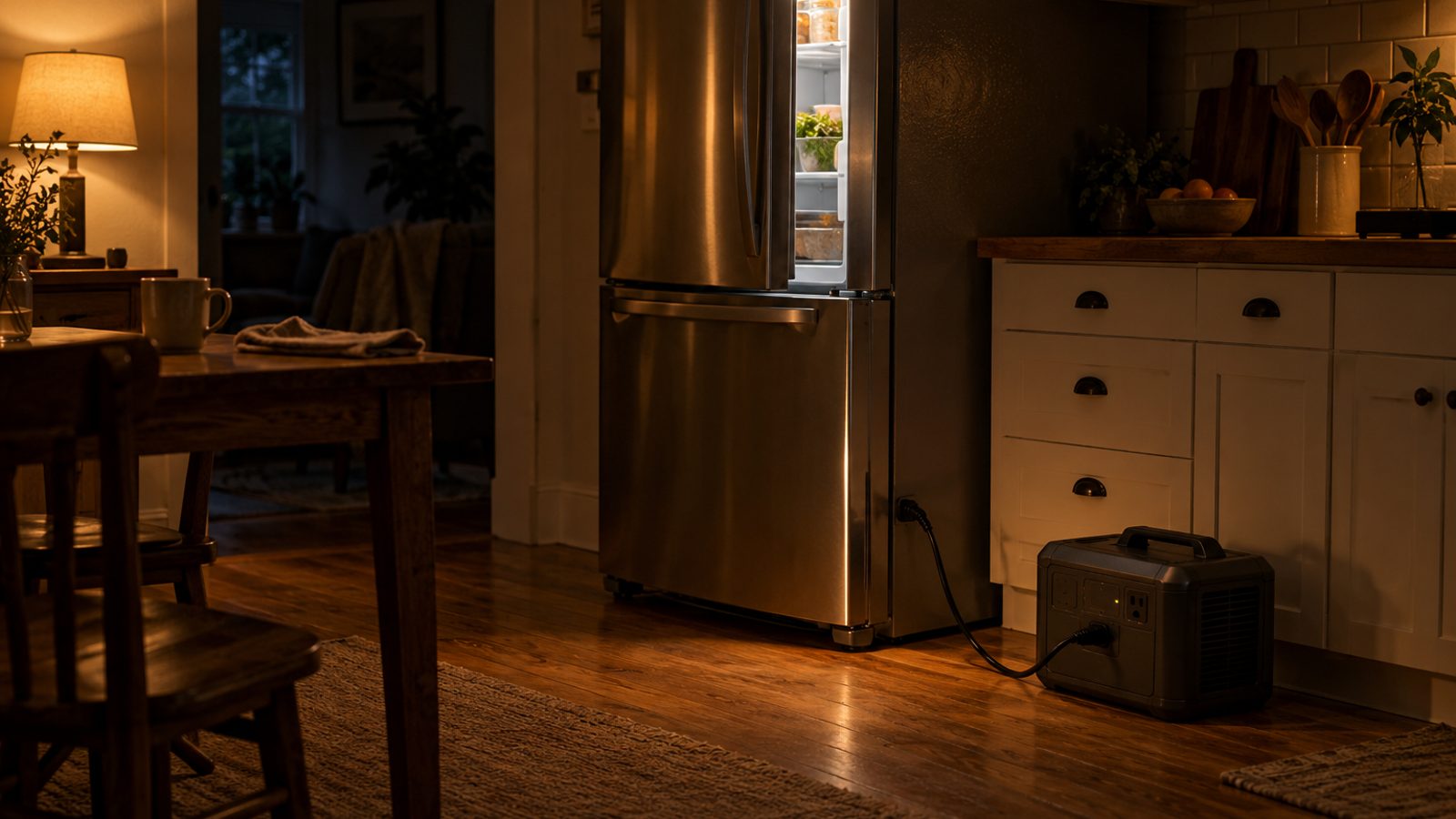
A large power station runs a full-size fridge for about a day. In CNET’s lab test, reported by wattpowerstation.com (updated October 25, 2026), the models it tracks ran one fridge for 12.58 to 38.58 hours. Battery size sets the ceiling. The power the station spends on itself decides how close you get to it.
The quick formula
Runtime (hours) = usable Wh ÷ (fridge average watts + station overhead watts)
- Find the kWh per year on your fridge’s yellow EnergyGuide label. Divide it by 8.76 to get average watts. A 500 kWh/year fridge averages about 57W.
- Add the station’s own draw. In the CNET data, that ranged from 12W to 74W.
- Divide the usable capacity by the total.
Usable capacity is lower than the number on the box. Inverter losses take a share, and so do the station’s own electronics.
Why fridge watts move around
A compressor switches on and off. For most of an hour it pulls little or nothing, then it starts with a short surge several times its running draw. A warm kitchen, a full door shelf of warm drinks, or a teenager browsing with the door open all add run time to the compressor. Your label figure is a lab average, and your real draw will often run above it.
Third-party test results by model
CNET ran 19 large power stations on the same full-size Whirlpool fridge (118V, rated 7.2A) until each one shut down. Wattpowerstation.com tracks 10 of them:
| Model | Rated battery | Fridge runtime | Share used on itself |
|---|---|---|---|
| Jackery HomePower 3600 Plus | 3,584Wh | 38.58 h | Not published |
| Jackery HomePower 3000 | 3,072Wh | 32.05 h | 36.4% |
| Anker SOLIX F3000 | 3,072Wh | 28.97 h | 37.81% |
| Pecron E3600LFP | 3,072Wh | 28.15 h | 15.75% |
| Anker SOLIX C2000 Gen 2 | 2,048Wh | 27.40 h | 18.21% |
| Bluetti Elite 200 V2 | 2,074Wh | 26.32 h | Not published |
| Bluetti FridgePower | 2,016Wh | 23.43 h | 20.24% |
| Dabbsson 2000L | 2,048Wh | 21.00 h | Not published |
| Goal Zero Yeti 1500 (6th gen) | 1,505Wh | 16.50 h | Not published |
| Oscal PowerMax 2400 | 1,872Wh | 12.58 h | 55.41% |
Source: CNET fridge test (published July 23, 2026), as compiled by wattpowerstation.com. The longest of all 19 units in that test was the Fossibot 3600 Pro at 44.65 hours.
A second tester, Scott Caine at solarpowerauditor.com, ran outage drills at home with different fridges. The EcoFlow DELTA Pro 3 kept a fridge, a freezer and a router going for 31 hours through a transfer switch. The Bluetti Elite 200 V2 ran a fridge and a router for 41 hours. Those runs used different appliances from CNET’s, so compare models within one source, not across the two.
The hidden loss: idle draw
The Oscal PowerMax 2400 shows the problem. It delivered 90% of its rated capacity at a steady 480W in CNET’s capacity test. On the fridge, it spent 55.41% of its energy on itself and posted the shortest runtime in the table. The Anker SOLIX F3000 has 50% more battery than the Anker SOLIX C2000 Gen 2, yet it ran the fridge only 1.57 hours longer, because it used 37.81% of its energy on itself against 18.21%.
A fridge is a small, stop-start load, and the inverter stays on the whole time. Look for independent idle-draw or low-load figures before you buy. A big rated number can hide a thirsty inverter.
How much capacity for a full day
Wattpowerstation.com works it out from CNET’s data: most tracked models used 66 to 91Wh for each hour the fridge ran. For a fridge like CNET’s, that means:
- 12 hours: about 800 to 1,100Wh usable
- 24 hours: about 1,600 to 2,200Wh usable
- 48 hours: about 3,200 to 4,400Wh usable
If you want to cover more than the fridge, total every load first with our sizing guide.
Making the battery last longer
- Keep the doors shut. FoodSafety.gov gives a closed fridge about 4 hours and a full freezer about 48 hours without power.
- Use ECO or AC-timeout settings for other outlets, but leave the fridge outlet on.
- Pack the freezer. Frozen jugs of water add thermal mass and keep the compressor off for longer.
- Turn the AC inverter off when nothing needs it. A 12V compressor fridge on the car port skips the inverter entirely.
- Plan a recharge. Solar panels or a small generator turn one day into several. See power station vs generator.
Our picks by budget
Our best portable power stations for home backup guide lines up the specs of the models we cover, from 1kWh units for one night to 4kWh wheeled batteries.
Frequently asked questions
Will a 1,000Wh power station run a fridge overnight?
Usually, yes. In solarpowerauditor.com outage drills, 1kWh-class units ran a fridge plus a router for 21 to 23 hours. Your result depends on your fridge, the room temperature and how often you open the door.
Can a power station handle a fridge compressor start-up surge?
At 1,500W of continuous output and up, generally yes. All 19 large units in the CNET test started and ran a full-size fridge rated at 7.2A at 118V. Check your fridge rating label and compare it with the station surge rating.
Does a chest freezer run longer than a fridge?
A chest freezer usually draws less per day and holds cold longer when you keep the lid shut. FoodSafety.gov says a full freezer keeps food safe for about 48 hours without power, against about 4 hours for a closed fridge.
Does UPS mode protect the fridge?
UPS mode switches the fridge from the wall to the battery when the grid drops, so nobody has to be home. Makers list switchover times of 10 to 20 milliseconds for the models in this guide. It does not make the battery last longer.